

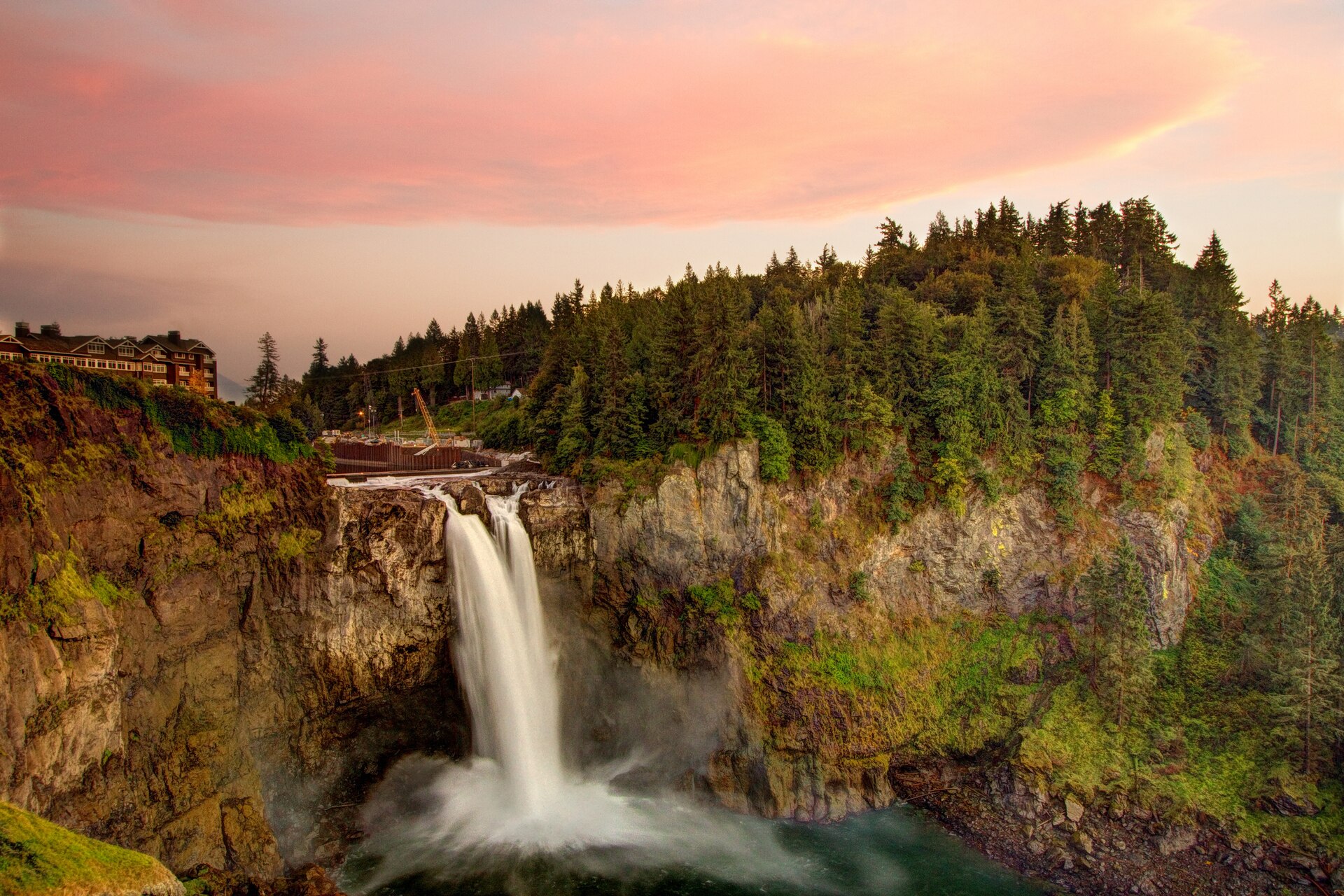
You hear it before you see it, a low, steady roar under everything, like wind in a forest that never stops. Then you step out onto the overlook in the early morning and the river simply falls away, 268 feet into a gorge full of white mist that rises and drifts back over the trees. The spray finds your face. The day-trippers have not arrived yet. It is just you, the sound and the water, doing what it has done here for thousands of years.
Salish Lodge and Spa was named to the Where to Stay: Nearby Nature category of the 2026 Sunset Travel Awards. There are grander hotels in the Northwest, but few with a setting this singular, and none with a story quite like this one.
Where you are, and whose place it is
Snoqualmie Falls lies on the Snoqualmie River between the towns of Snoqualmie and Fall City, about 30 miles east of Seattle at the foot of the Cascades. For the Snoqualmie people, the falls have always been a sacred place, where the mist was said to carry prayers up to the Creator, and a place where many tribes gathered in peace. The first lodge was built at the top of the falls in 1916, at a time when Native people were not welcome inside.
History turned. The Snoqualmie Tribe, whose federal recognition was restored in 1999, bought the lodge and about 45 acres around the falls in 2019 for $125 million, from the Muckleshoot Tribe, to protect the site and reclaim ancestral land. The lodge is owned by the Tribe and run by a hospitality management company. Knowing that changes the way you stand at the overlook. This is not scenery. It is someone’s holy ground, returned.
The falls have other histories, too. Just below the lip sits one of the world’s first completely underground hydroelectric plants, built in 1899 and still operating. And for a generation of television viewers, the lodge and the falls are forever the opening credits of Twin Peaks.
| Location | 6501 Railroad Ave SE, Snoqualmie, Washington, at the top of Snoqualmie Falls |
|---|---|
| The falls | 268 feet on the Snoqualmie River; more than 1.5 million visitors a year |
| Ownership | Snoqualmie Tribe since 2019, which acquired the lodge and about 45 acres around the falls |
| Rooms | Fireplaces and deep soaking tubs throughout; many rooms face the river or valley |
| Spa | A full spa built around soaking and warmth, suited to Northwest rain |
| Nearby | Mount Si, Little Si, Rattlesnake Ledge, Twin Falls, Snoqualmie Valley Trail |
The stay itself
The lodge is a warm, low-lit refuge in the style of the Northwest: wood, stone, big fireplaces, and rooms with soaking tubs made for rainy afternoons. The spa is the other half of the reason people come, a place to move from hot water to steam to a quiet room while the weather does what it will outside. Dining leans on regional ingredients, and the lodge’s famous country breakfast has been a Snoqualmie ritual for generations.
The honest caveats: more than a million and a half people visit the falls every year, and the public park and overlook sit right beside the lodge. By midday the paths are busy. The trick is to use the privilege of staying the night. Walk to the overlook at dawn, or after dark when the falls are lit, and you will often have the roar nearly to yourself.
Out the door: the country within an hour
The river trail to the lower falls
From the upper park, a trail drops about 0.7 miles and nearly 400 feet through mossy temperate rainforest to the river, past the historic 1910 powerhouse, to a boardwalk looking back up at the falls from below. It is steep on the return and worth every step, especially in spring when the river runs high.
Mount Si and Little Si
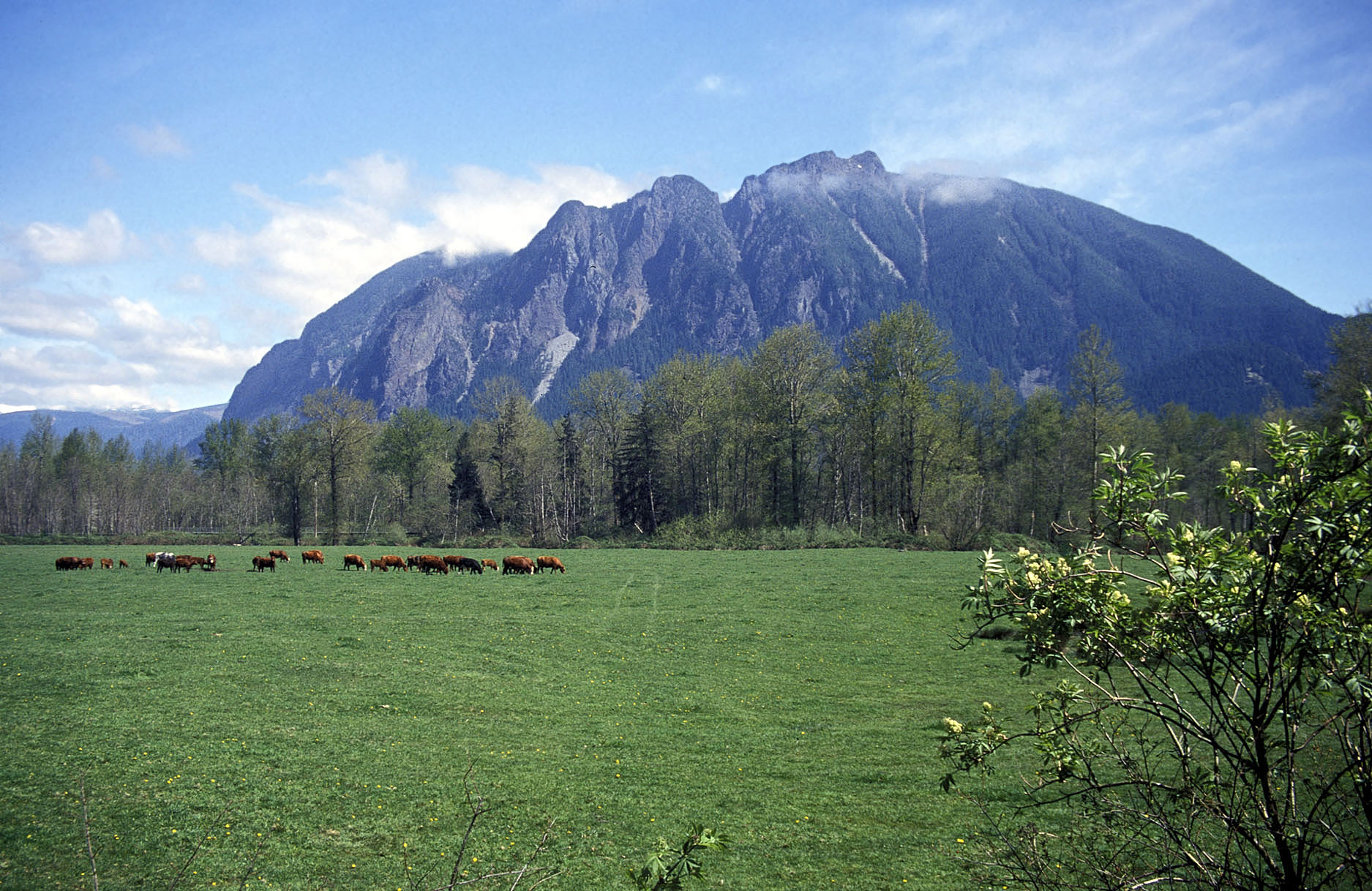
Fifteen minutes east near North Bend, Mount Si is the region’s great training climb, about eight miles round trip with more than 3,000 feet of gain to a rocky summit haystack overlooking the Snoqualmie Valley. Little Si, next door, offers a shorter, gentler climb through mossy boulders to a fine view. Both are busy on weekends; weekday mornings are best.
Rattlesnake Ledge and Twin Falls
Rattlesnake Ledge climbs from the shore of Rattlesnake Lake to a rock ledge with a dizzying view over the lake and the Cedar River watershed. Twin Falls State Park, a short drive east, follows the South Fork Snoqualmie through old-growth forest to a bridge above a pair of waterfalls. Both are classic, family-friendly half days.
The Snoqualmie Valley Trail and the Greenway
The old railroad grade of the Snoqualmie Valley Trail runs for more than 30 miles through farmland and forest, ideal for an easy bike ride. It is part of the Mountains to Sound Greenway, a 1.5-million-acre landscape of protected forests, farms and trails along the I-90 corridor from Seattle over Snoqualmie Pass, and one of the great conservation stories in the country.
When to go
The falls are at their most powerful from late fall through spring, when rain and snowmelt swell the river, and in winter the spray can freeze on the trees. Summer brings the driest trail weather, from July through September, and long evenings. Fall adds color and the first storms. Honestly, the lodge was made for the wet months: a room with a fire, a soaking tub and a waterfall roaring outside is the Northwest at its best.
What our place data shows
Against the Ideal Location trail atlas, Salish Lodge shows 5 mapped trails within five miles and 55 within ten, among them Mount Si, Little Si, Rattlesnake Ledge, Twin Falls, the Snoqualmie Valley Trail and the Snoqualmie Falls trail itself. That makes it one of the best-connected trail bases in this series, all within a short drive of the room.
Our nonprofit directory shows the people behind it: the Mountains to Sound Greenway Trust, which has spent decades protecting this corridor, and, in North Bend, Friends of the Trail, whose volunteers clean up and care for the area’s public lands.
Our EARTH read
A provisional, editorial read against Ideal Location’s five EARTH dimensions, based on public information rather than a verified assessment. Here is how the EARTH Watchlist works.
| Experiences | Exceptional. A 268-foot waterfall at the door, and a place of deep cultural meaning. |
|---|---|
| Adventures | Strong. Dozens of classic trails within a short drive. |
| Rejuvenation | Exceptional. Fireplaces, soaking tubs and a spa made for rain. |
| Togetherness | Good. Suited to couples and small gatherings more than big groups. |
| Home | Strong. A century-old lodge on land now back in the hands of its first people. |
The verdict: a lodge whose setting would be enough on its own, deepened by one of the most meaningful ownership stories in American hospitality. Stay the night, walk out at first light, and the crowds become a rumor.
Questions travelers ask
Who owns Salish Lodge and Spa?
The Snoqualmie Tribe has owned Salish Lodge and Spa since 2019, when it acquired the lodge and about 45 acres around Snoqualmie Falls for $125 million. The lodge is operated by a hospitality management company.
How tall is Snoqualmie Falls?
Snoqualmie Falls drops 268 feet on the Snoqualmie River, about 30 miles east of Seattle. More than 1.5 million people visit each year.
Can you hike to the bottom of Snoqualmie Falls?
Yes. A trail descends about 0.7 miles and nearly 400 feet from the upper park through rainforest to a boardwalk viewpoint of the lower falls. The return climb is steep.
What are the best hikes near Salish Lodge?
Mount Si, Little Si, Rattlesnake Ledge and Twin Falls are all within about 20 minutes. The Snoqualmie Valley Trail offers easy biking on a former railroad grade.
When is the best time to see Snoqualmie Falls?
The falls are most powerful from late fall through spring after rain and snowmelt. Early morning and evening visits avoid most of the crowds.
Landscape photographs are freely licensed via Wikimedia Commons, with photographers credited beneath each image. Property details were checked against the hotels’ own published information and the sources noted in the text as of September 2026; rates and seasons change, so confirm before you book.